News Center

Home | News Center

Contact us

  • Tel/Whatsapp:

    +86 13640473840

  • Email:

    alvin@atofei.com

  • Address:

    Building B, No. 8 Shengye South Road, Huangpu Town, Zhongshan City, Guangdong Province

Material Insights

Creation date:2026/6/24 10:19:46


Based on material type, the market is segmented into polypropylene (PP), polyethylene (PE), polyvinyl chloride (PVC), polystyrene (PS), acrylonitrile butadiene styrene (ABS), and others. In 2023, polypropylene dominated the market with a share of 47.2%. Due to its superior toughness, chemical resistance, and adaptability, PP is widely used in the production of in-mold labels and finds extensive applications across packaging, food & beverage, household goods, personal care, and other industries.

Acrylonitrile butadiene styrene (ABS) also constitutes a key segment of the market owing to its smooth surface and excellent printability. In-mold labeling requires precise, high-quality printing to ensure clear and vibrant graphics. ABS facilitates ink and coating adhesion, enabling sharp and durable printed effects on labels. It also exhibits resistance to a wide range of chemicals, including solvents and oils.

Production Process Insights

Injection molding dominates the production process segment. In this technique, molten plastic material is injected into a mold cavity containing the label. During molding, the label fuses with the plastic substrate, achieving seamless integration with the container or product. Injection molding enables precise, high-speed production of in-mold labeled products, making it suitable for large-scale manufacturing.

The thermoforming production process is projected to witness a notable CAGR of 3.6% from 2024 to 2030. This method is primarily used for applications requiring large, shallow containers or products. In thermoforming, a plastic sheet is heated until pliable and then formed into the desired shape using a mold. The label is placed into the mold prior to forming, allowing it to bond with the substrate during the shaping process. Thermoforming is commonly employed in packaging applications for industries such as food and beverage, where large, shallow containers are frequently used.

Printing Technology Insights

Based on printing technology, the market is segmented into flexography, offset printing, gravure printing, digital printing, and others. Flexography is widely used in in-mold label (IML) production due to its suitability for printing on flexible substrates such as plastic films or paper.

Digital printing enables high-resolution output with vivid colors and fine details. This allows complex designs, photographic images, and variable data to be reproduced with exceptional clarity and precision. Digital printing eliminates the need for printing plates, reducing setup time and lowering costs for short- to medium-run orders.

Application Insights

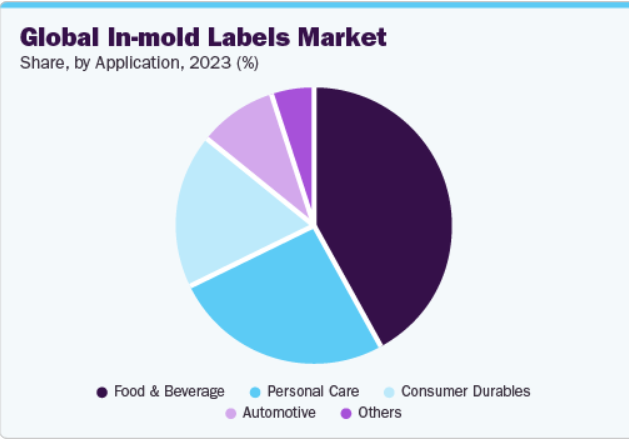
Compared to conventional labeling methods such as pressure-sensitive labeling or sleeve labeling, in-mold labeling offers multiple advantages, including enhanced durability, abrasion resistance, and improved aesthetic appeal.